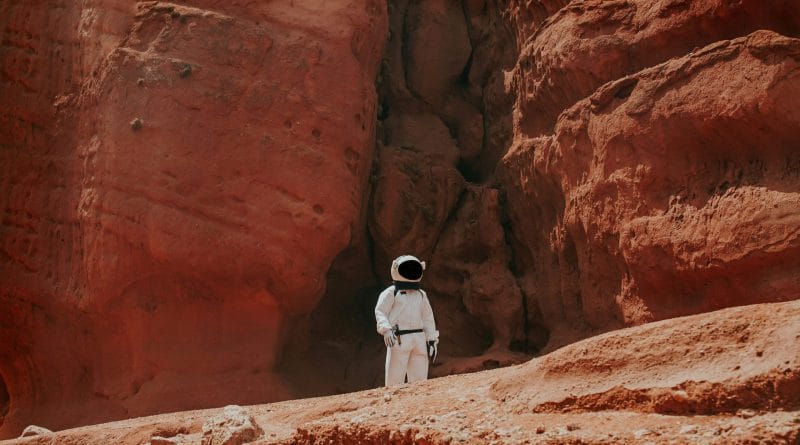
The Race to Mars in 2026: Are We Finally Ready for the Red Planet?
For decades, landing on Mars was science fiction. Today, it is an engineering schedule.
In 2026, the question is no longer “if” we will go, but “when.” The Science of space travel has advanced more in the last five years than in the previous fifty, driven by a fierce competition between government agencies and private billionaires.
The Race to Mars is not just about planting a flag; it is about survival. As Earth faces climate challenges, becoming a multi-planetary species is seen by many visionaries as the ultimate insurance policy for humanity. Here is where we stand right now.
SpaceX and the Starship Revolution
You cannot talk about Mars without talking about Elon Musk. His vision has always been singular: build a self-sustaining city on the Red Planet.
The vehicle for this vision is Starship. Unlike the Apollo rockets of the 1960s which were thrown away after one use, Starship is fully reusable. This is the holy grail of space economics. If you can refuel and relaunch a rocket like an airplane, the cost of sending supplies to Mars drops from billions to millions.
In 2026, SpaceX is pushing the limits of physics, conducting orbital tests that bring us inches closer to the months-long journey across the void.
NASA and the Artemis Gateway
While private companies move fast, NASA moves with precision. Their strategy is the “Moon-to-Mars” approach.
Before jumping to Mars, NASA is establishing a permanent presence on the Moon through the Artemis program. The goal is to build the “Lunar Gateway”—a space station orbiting the Moon. This will serve as a training ground and a fueling station.
Testing technologies on the Moon (which is 3 days away) is much safer than testing them on Mars (which is 6 months away). If something breaks on the Moon, you can come home. If something breaks on Mars, you are on your own.
The Human Challenge: Radiation and Gravity
Building the rocket is actually the easy part. The hard part is keeping the passengers alive.
Space is a hostile environment. Astronauts traveling to Mars will be exposed to cosmic radiation that can damage DNA and increase cancer risk. Engineers are currently developing new shielding materials using hydrogen-rich plastics and even water to block these rays.
Then there is the issue of gravity. Mars has only 38% of Earth’s gravity. We still do not fully understand how the human body reacts to low gravity for years at a time. Bone density loss and muscle atrophy are serious risks that Doctors and scientists are racing to solve before the first crew departs.
Looking for Life
Why go at all? Beyond survival, there is the ultimate scientific question: Are we alone?
Rovers like Perseverance have already found evidence that Mars once had rivers and lakes. Sending humans there allows for deep drilling and geology that robots simply cannot do. Finding even a single fossilized microbe on Mars would change our understanding of the universe forever, proving that life is not unique to Earth.
The Next Giant Leap
The window for launching to Mars only opens once every 26 months, when the planets align. Each window is a deadline that drives innovation.
The Race to Mars is more than a competition between nations or companies. It is a testament to human curiosity. Whether it is a NASA astronaut or a SpaceX colonist who takes that first step, the moment a human boot touches the red dust, history will be rewritten. We are standing on the precipice of a new era of exploration.